Thoth, Hermes and the Book of Thoth: Four Things to Keep Distinct
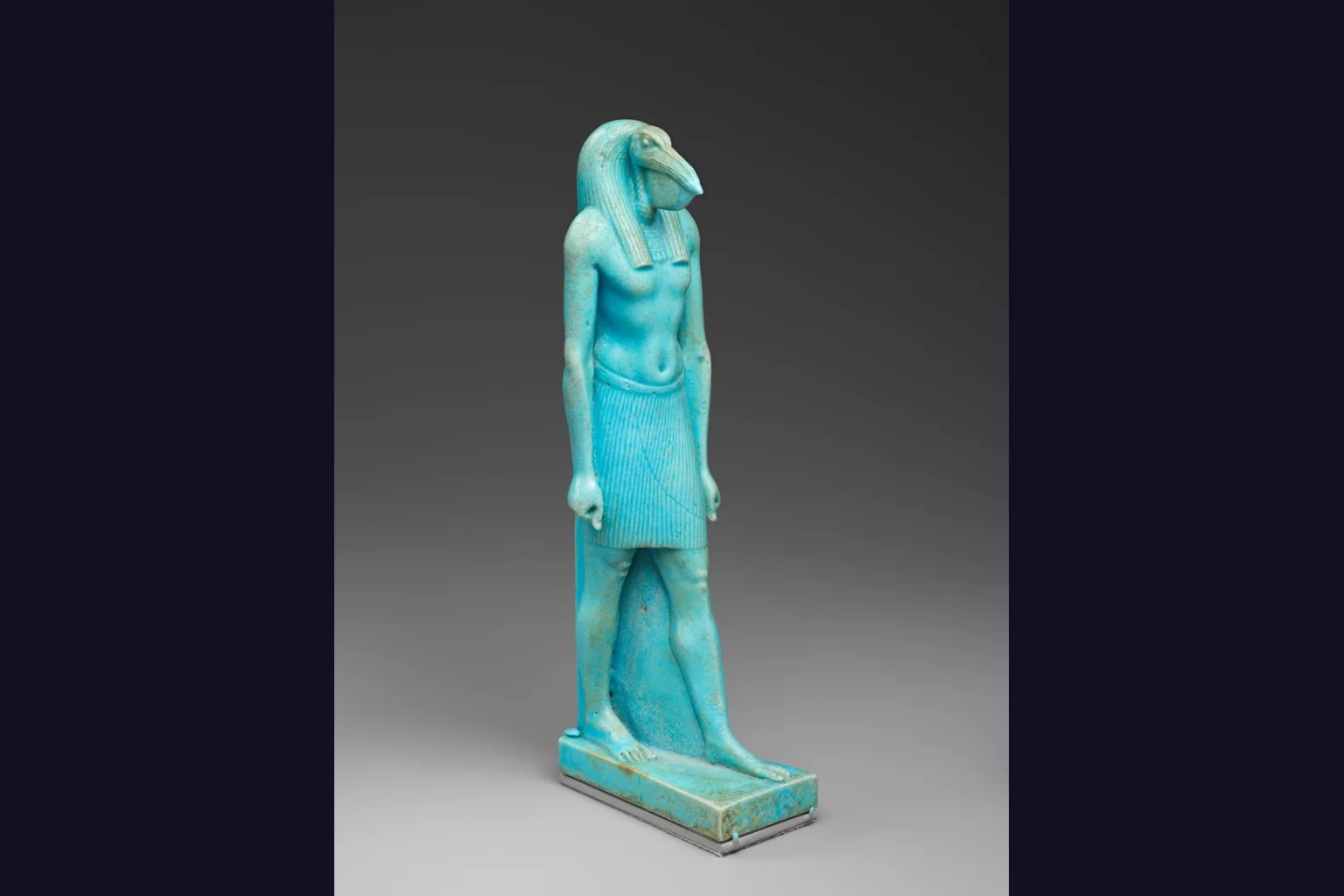
Striding Thoth, 332-30 BCE, accession 26.7.860. The Metropolitan Museum of Art, Purchase, Edward S. Harkness Gift, 1926. Public-domain Open Access photograph; editorial framing added. This sculpture is not an illustration of either Book of Thoth.
A search for Thoth can lead from an Egyptian museum object to a philosophical dialogue and then to a Tarot deck. The shared name is an invitation to investigate, not a reason to put everything in the same historical category. Start by asking what is actually in front of you: a deity's representation, an attributed teacher, an ancient text, or a modern interpretation.
This guide follows four distinct references. Keeping them apart does not diminish their fascination. It lets you appreciate the surviving objects and writings without asking one to prove the history of another.
1. Thoth: begin with a documented Egyptian object
The Metropolitan Museum of Art identifies Thoth as a god of writing and accounting, represented by an ibis or a baboon. Its Striding Thoth, accession 26.7.860, takes the form of an ibis-headed figure in blue faience. The catalogue dates this particular sculpture to 332-30 BCE, in the Ptolemaic Period. That is the object's date, not a date for the origin of the deity.
Look at the figure before moving to a symbolic interpretation. What material is named? What survives? Which details can you see, and which are explained by the museum? Keeping the accession number beside your notes lets you return to a specific piece rather than a generic image of Egyptian wisdom.
Evidence: The Met - Striding Thoth, 26.7.860
2. Hermes Trismegistus: identify the literature
The Cambridge Handbook of Western Mysticism and Esotericism describes Hermes Trismegistus through the identification of Greek Hermes with Egyptian Thoth, while noting that accounts of his genealogy differ. It dates the seventeen short treatises of the Corpus Hermeticum to the second and third centuries CE. This is a defined body of literature, not another name for every book that invokes Thoth.
When reading a Hermetic passage, record the treatise and the translator. A modern edition date tells you when that edition appeared; it does not date the ancient composition. Our separate Kybalion comparison offers another useful boundary: a shared Hermetic vocabulary does not make works from different periods interchangeable.
Evidence: Cambridge Handbook - Renaissance Hermetism (chapter summary)
3. The ancient Demotic Book of Thoth: a dialogue in fragments
The Johns Hopkins description of Richard Jasnow and Karl-Theodor Zauzich's edition introduces an Egyptian work preserved in more than forty Graeco-Roman papyri, largely in Demotic script. It is organised as a dialogue between a divine figure, possibly Thoth, and a human seeker. Writing, sacred geography and temple knowledge belong to its subject matter. The possibility in that identification matters: do not turn it into an unqualified statement that Thoth speaks every line.
The reader-oriented Conversations in the House of Life offers a more approachable translation and describes the work as a possible initiation text. That is an interpretation to examine, not a licence to reconstruct an ancient ceremony from a summary. The edition's description also leaves the relationship to the Greek Hermetic corpus open rather than declaring the two to be the same teaching.
The 2021 supplement to The Ancient Egyptian Book of Thoth adds fragments and revised readings. It is a useful reminder that a reconstructed ancient work can change as scholars study more evidence. Distinguish the modern title and publication history from the age of the papyri themselves.
Evidence: Johns Hopkins - The Ancient Egyptian Book of Thoth; Harrassowitz - Conversations in the House of Life; Harrassowitz - The Ancient Egyptian Book of Thoth II
4. The modern Book of Thoth: a different work
The Grolier Club's exhibited first edition of Aleister Crowley's The Book of Thoth is dated 1944 and identifies Frieda Lady Harris's illustrations. It is a twentieth-century Tarot work. It is not the Demotic dialogue described above, and the shared title does not establish that its cards reproduce an ancient Egyptian book.
For the historical setting of Tarot, Tim Husband's Met essay points to fifteenth-century Northern Italian references to the game. This is a different evidential starting point from Egyptian papyri or a Ptolemaic sculpture. Later Egyptian symbolism can be studied as an interpretation in its own right without being treated as proof of Tarot's ancient Egyptian origin.
Evidence: Grolier Club - The Book of Thoth, first edition (1944); The Met - Tim Husband, Before Fortune-Telling: The History and Structure of Tarot Cards
A contemporary practice: separate evidence from response
Choose one source from this guide. Label it with the work or object, its date, its author or translator where known, and the kind of evidence it offers. For a museum object, include the accession number. For a book, distinguish the edition you are reading from the period discussed in it.
Then complete two sentences: The source establishes ... and This makes me wonder ... . Keep the second sentence open and personal. This is a contemporary reading exercise, not an ancient Egyptian ritual. It gives imagination room while keeping the evidence visible.
Where to go next
If the object drew you in, continue with the Thoth profile and the museum collection. If the literature is your interest, read the Kybalion and Corpus Hermeticum comparison before choosing an edition. For Egyptian religious practice in its historical setting, the Heka guide is a better next step than a modern correspondence chart.
You do not need to reconcile all four references into a single system. A careful question, a dated source and a clear distinction between history and reflection are already a good beginning.
Sources & References
- The Met - Striding Thoth, 26.7.860
- Cambridge Handbook - Renaissance Hermetism (chapter summary)
- Johns Hopkins - The Ancient Egyptian Book of Thoth
- Harrassowitz - Conversations in the House of Life
- Harrassowitz - The Ancient Egyptian Book of Thoth II
- Grolier Club - The Book of Thoth, first edition (1944)
- The Met - Tim Husband, Before Fortune-Telling: The History and Structure of Tarot Cards